MARCH 2024

Innovation and Strategy for the Small American College
from W. Kent Barnds and Augustana College
WELCOME
This is the first edition of what I plan to be a quarterly communication about strategy and innovation in higher education with a special focus on smaller colleges.
In each newsletter, I plan to:
- Provide marketplace examples worthy of your consideration.
- Share articles and resources that I find especially useful to thinking about strategy and innovation in higher education.
- Share a specific example of something you can do as you work to develop or implement strategy or take some innovative steps on your campus.
A confluence of two events inspired me to create this newsletter: a change in my professional responsibilities to focus on strategy and innovation at Augustana College, and the recent development of a new strategic plan — the fifth one in my 19 years here!
I hope you or someone on your campus can join me in an exchange of information and dialogue about strategy and innovation in higher education.
W. Kent Barnds
Executive Vice President for Strategy and Innovation
Augustana College, Rock Island, Ill.
FIRST, SOME OBSERVATIONS
While successful mergers and acquisitions remain somewhat rare in higher education, especially among smaller colleges, I have noticed a handful of colleges that are purchasing a competency as a way to add programs and presumably innovate for the future.
These incidents have intrigued me because the typical response for small colleges is to build their own program and develop their own capacity, rather than acquire it. It may be too soon to assess the outcome, but it does seem like acquiring a strength is new to higher education.
Here are three examples that caught my attention:
- When Finlandia University in Hancock, Michigan, closed, neighboring Michigan Tech University sprang into action to essentially move Finlandia’s successful nursing program to their campus. Michigan Tech hired faculty from Finlandia and integrated their program into Michigan Tech. While not a traditional acquisition for this STEM-focused university, given Finlandia’s closure and the need for nursing education in Michigan’s Upper Peninsula, Michigan Tech’s assumption of the nursing program has an impact.
- Gettysburg College recently entered into a partnership to offer an online master’s degree, which is novel for a residential undergraduate college of the liberal arts. It’s difficult to know if this is part of a long-term plan for Gettysburg to add online and graduate programs, but this new master’s degree in American history seems a fortuitous combination of tradition and innovation to add new strength and capacity.
- This past fall Calvin College in Michigan acquired Compass Film School. This is another example of a small college making a strategic acquisition to expand its reach academically and geographically.
If you have other examples or thoughts you’d like to share, please email me at wkentbarnds@augustana.edu.
A USEFUL RESOURCE
One of the most valuable resources I found, going through the strategic planning process at Augustana College this time around, was this video clarifying the difference between strategy and a strategic plan.
I think you will like it, too, especially if you are a planning geek like I am.
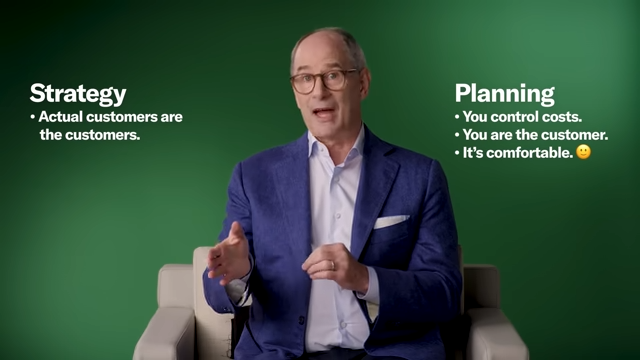
Truth be told, the message in this video helped shape Augustana’s strategic plan. It led to a clear statement of strategy around which we can rally.
How are you distinguishing your strategy from your plans, and articulating the difference?
SOMETHING TO TRY AT HOME
One of my favorite strategic planning exercises is developing alternative futures.
Several years ago, before Ben Sasse was a U.S. Senator or Chancellor of the University of Florida, he was president of Midland University in Fremont, Nebraska. He invited another higher ed professional and me to develop alternative futures for Midland, which was then at an inflection point.
The idea was for two outsiders to pitch six one-page alternative futures to President Sasse and the board of trustees.
I still remember the ideas:
- Shrink the majors, grow the badges.
Develop certificates and testing for the most-demanded skills. - More local AND more distant.
Thicken the residential culture with college houses and hybridize the curriculum with the best internet content. - One-year track for internationals.
Create a pathway for reverse study-abroad students to enroll in a residential study + Omaha internship program. - The nation's 8th work college.
Build a campus with universal work and internships en route to 40-year lifetime learning relationship rather than 4-year edu-vacation relationship. - Simultaneous college admission and internship hiring.
Build five deep partnerships with Omaha employers to accept 10+ student-workers annually into multi-year rotating field experiences. - First generation college-goer boot camp.
Reenvision the college experience with more intentional filtering around desire and work ethic than preparedness, recrafting especially the transition year.
Thinking about alternative futures, especially with an element of competition, was a great way to really engage the creativity and strategic thinking of the group. I’ve used this exercise since and continue to believe it adds value to any strategic discussion. Give it a try.
PROFESSIONAL DEVELOPMENT OPPORTUNITIES
for Chief Strategy Officers
Since I am new to my role, I am always looking for new professional development opportunities.
As part of this newsletter, I will share opportunities I run across. Here are two:
Academic Impressions Chief Strategy Officer Roundtable
I participated in this program this past fall and found it enormously beneficial.
University of Pennsylvania’s Chief Strategy Officer Program
This program, offered through the University of Pennsylvania has been present in my LinkedIn feed for the past few months and looks very interesting, too.
What new thoughts has this issue stirred in you, as you consider strategy and innovation for the small college?
Do you have any ideas you’d like to pursue in dialogue?
Connect with me
W. Kent Barnds
Executive Vice President for Strategy & Innovation
Vice President of Enrollment & Communication
Augustana College, Rock Island, IL 61201
wkentbarnds@augustana.edu
Connect on LinkedIn
This message is sent on behalf of Augustana College