JULY 2025

Innovation and Strategy for the Small American College
from W. Kent Barnds and Augustana College
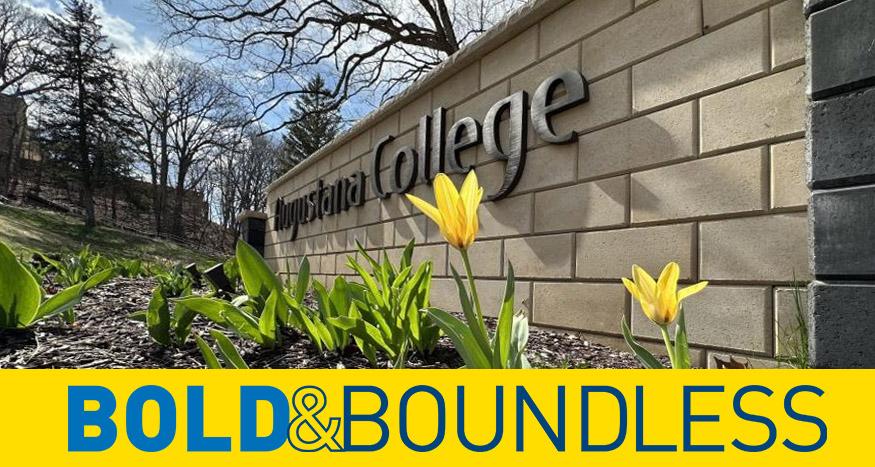
Welcome to Issue 6 of Innovation and Strategy for the Small American College.
In January 2024, Augustana College’s Board of Trustees provided sponsorship to our strategic plan, Bold & Boundless, and the underlying strategy for the college.
Since that time the community has been hard at work developing plan-aligned initiatives, launching new programs and developing the measurements that will showcase our success in positioning the college for the future and seizing upon those actions enabling us to win.
We’ve also been learning a lot about what does and does not work. In this issue I share some of the things we’ve learned and how it’s changing our approach without diverting us from our strategy.
W. Kent Barnds
Executive Vice President for Strategy and Innovation
Augustana College, Rock Island, Ill.
What we've learned
1. Three design teams became one big, giant, super design team.
In late fall, three small design teams were appointed a timeframe within which to offer one bold idea. We followed all of the best practices: a small group of committed volunteers, an agile agenda and a time-bound task.
The three design teams revolved around the following themes:
- Expanding how credit is awarded.
- Creating integration and interdisciplinarity across majors.
- Revising and boosting Viking Scorecard (a measurement of student progress on their academic and career goals).
They worked with resolve, passion and deep curiosity about what the other design teams were developing.
We provided the design teams with additional support and intentionally kept them small. We also asked people with expertise in a particular functional area to participate in a design team outside of their expertise.
These were highly engaged professionals and they did their work. When the time came for them to turn in their homework, they all did so and offered some clever and creative ideas.
And yet, there didn’t seem to be a big idea, and there was an awful lot of overlap or interdependence. It felt like we sent off three groups to solve the same problem, but didn’t give them all of the tools they needed to do so.
When I met with President Andrea Talentino after she had reviewed the recommendations, she asked:
Could the recommendation be bigger and bolder if we combined the three design teams into one, asked them to identify the connective tissue among the three ideas and invited them to think about institutional impact?
She saw something that we probably should have seen earlier: these three distinct groups were stronger together.
Shortly after receiving the recommendations from the three design teams, President Talentino asked the three chairs if they were up to serving longer and leading a "super design team."
They all agreed and are working on a big, bold idea right now.
Key lesson: Be agile and ready to adjust your plan and plans to get to the most out of people and ultimately realize the greatest impact.
2. What if you promised to measure outcomes and not activity, but your outcome is years away?
One of our strategies is to take the necessary actions to impact our surroundings to create a stronger sense of belonging and engagement for our students and our community. It’s a great strategic goal, but it’s hard to imagine a valuable short-term goal to measure our success, which was pointed out by our provost, Dr. Dianna Shandy, at a recent quarterly meeting about plan implementation.
As we were reviewing our implementation dashboard, she identified that goal three of our plan — connect through partnership — isn’t really being measured at all.
So, how do we measure our success, other than sharing a list of all of the stuff we are doing, which we said we wouldn’t do? We are facing that right now and trying to be creative in our approach without just developing a list of activities and actions.
Key lesson: Be prepared for patience and accept hypotheses. Like scientific research, sometimes strategic success cannot fully be measured for years.
3. We are still struggling with what is important and what is strategic.
Not surprisingly, we continue to struggle with differentiating between those things that are important and those that are strategic. Campus community members at times feel like their important work is insufficiently valued because it is not recognized alongside various strategic initiatives highlighted in communications.
I think those of us responsible for implementing Bold & Boundless are sympathetic to the bruised feeling, but we also have to be intentional about our direction.
While I am sure people on campus are tired of hearing the following example, it’s useful in this circumstance: Compliance is important, but it is not strategic. Aspiring to be the most compliant organization will not position the organization to win.
Key lesson: You cannot explain the difference between important and strategic too many times. Intentionally differentiating between those things that are important and those that are strategic is essential, so repeat it frequently enough, and people will start to get it. But maybe come up with more than one example.
Innovation is hard to describe.
Innovation in higher ed is often viewed as scary, or an abandonment of traditions. I just finished 20 years at Augustana and took some time to reflect on 20 years and what I think has been innovative at Augustana.
A resource worth reviewing
Ever since I saw this HBR article, I’ve been trying to think about a visualization of our strategic plan. The authors argue that a one-page slide visualization of your plan is the best way to engage employees and investors. I think there is some real wisdom to that idea, and it’s a darn good challenge to visual communicators.
Professional development opportunities for CSOs
Are you a chief strategy officer? Share what’s guiding you in your work for your institution.
Let's connect.
Connect with me

W. Kent Barnds
Executive Vice President for Strategy & Innovation
Vice President of Enrollment & Communication
Augustana College, Rock Island, IL 61201
wkentbarnds@augustana.edu
This message is sent on behalf of Augustana College