OCT. 2025

Innovation and Strategy for the Small American College
from W. Kent Barnds and Augustana College
#1 for innovation among liberal arts colleges in Illinois

Welcome to Issue 7 of Innovation and Strategy for the Small American College.
Too often, a change in leadership resets a college’s planning cycle. But strategy shouldn’t change just because the president does. Every institution faces moments of transition and uncertainty, and those moments reveal whether the strategy is truly embedded in the organization or tied too closely to a leader or plan.
At Augustana College we are in the messy stages of implementing our strategic plan. There are discussions about resources, timing, impact, alignment – the hard, necessary work that comes with execution. Some on campus are watching how this takes shape and trying to figure out how to fit in. Like many of you, we are doing this within a very uncertain external environment.
This edition explores how to stay grounded in an enduring strategy even during transition or uncertainty, and how to keep your community informed and engaged when it’s time to narrow the focus of what gets done.
Finally, I have three questions for you, and I invite your feedback.
I hope you will find this useful no matter where you are in your strategy journey.
W. Kent Barnds
Executive Vice President for Strategy and Innovation
Augustana College, Rock Island, Ill.
Strategy must be enduring, even if a strategic plan is nimble
Earlier this month Stellantis announced that it plans to delay its strategic plan while the organization onboards new leadership and navigates the new regulatory environment. This move made headlines and impacted investor sentiment when it was first announced. While Stellantis is a behemoth auto company and not a small college, I couldn’t help but think of how similar this is to what often happens in higher education.
Often leadership transitions in higher education revolve around the natural end of a strategic plan and the need for a new one. Indeed, it’s pretty rare for a new president not to be charged with immediately putting together a strategic plan.
As at Stellantis, there are good reasons for asking new leaders in higher ed to tackle planning. A strategic planning process provides a new leader with the opportunity to do a deep dive into what the community does well and what it may need to do better. The nature of strategic planning in higher education also tends to engage a broad group of stakeholders, which might be a little different from Stellantis, where they seem to be pausing to let a new CEO chart the path forward.
While there are very good reasons for pausing or standing up new planning processes or plans when new leadership begins, the very best organizations differentiate organizational strategy from strategic planning. Plans can be nimble, but strategy must endure transition or external disruption. If not, there is a much greater likelihood of drift away from institutional success over the long term. This is one of the main reasons that it is so important to have a clear sense of the difference between organizational strategy and its strategic plan.
The difference between strategy and plan
Augustana’s current strategic plan, Bold & Boundless, clearly differentiates our strategy, which is long-term, from our strategic plan, which we hope to complete by 2030.
Dr. Marc Sniukus developed this useful tool to remind us of the difference.
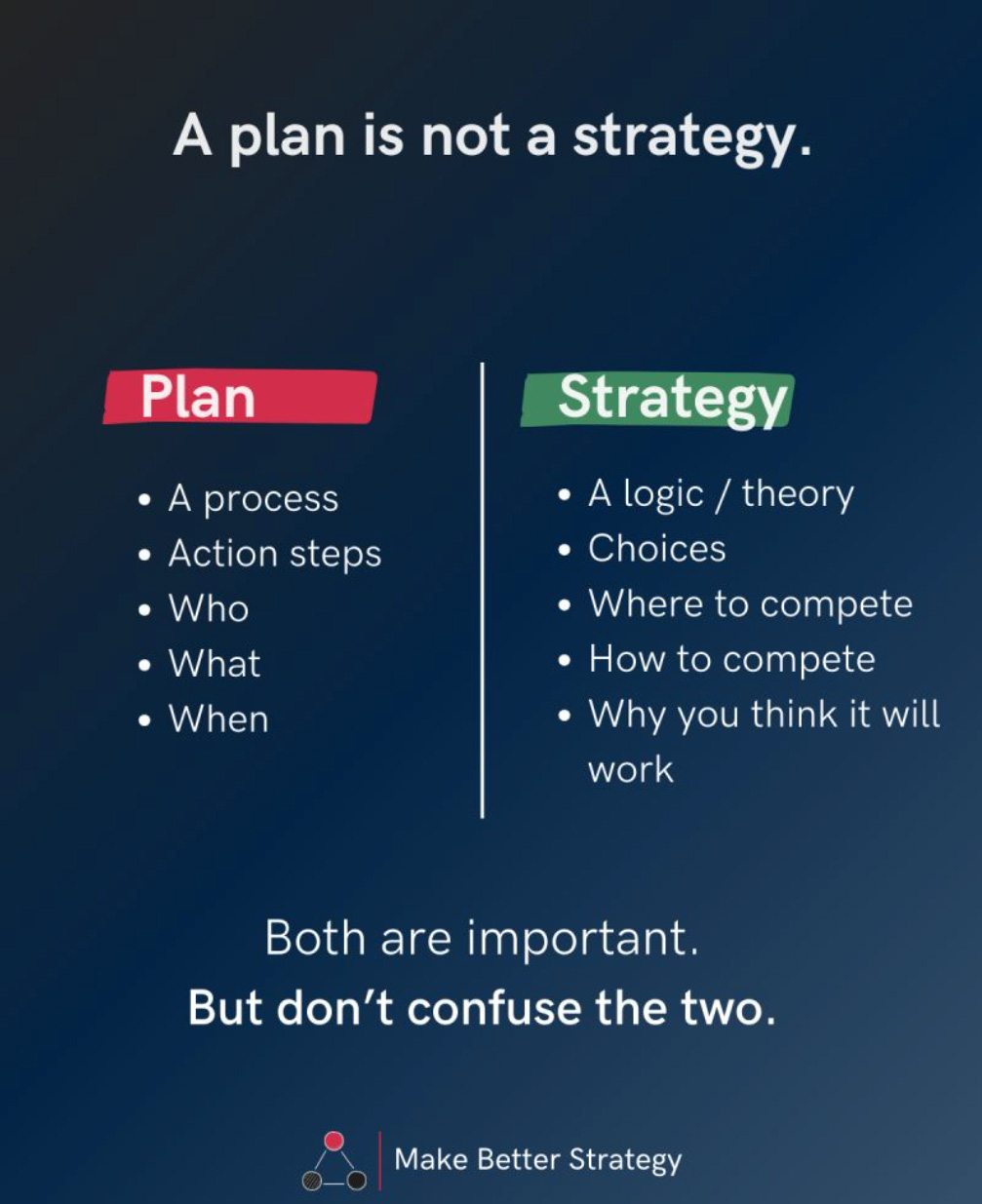
Key lesson: Strategic plans can be nimble, but organizational strategy must endure through transition or external disruption.
Two years in, we are starting to say “no” and focus
There’s been a noticeable change this academic year as more and more plan-aligned ideas take shape and move to implementation.
What is the change?
We stopped asking people to come up with more ideas, and instead decided to draw focus to the ideas that we believe will impact the most students. For us, this is a sharp contrast to the last two academic years, during which the Strategic Plan Implementation Council was actively soliciting activation proposals and working to get executive sponsorship of great ideas.
The current tone is different, for sure. We are sensitive to the fact that some on campus might feel there’s been enough of Bold & Boundless and now it’s time to put it on the shelf, as is often the case with strategic plans.
However, we’ve been deliberate in identifying and contextualizing this change, so our campus community knows that there is important work being done, and that we need to put our energy into elegant and faithful implementation of good ideas.
To align members of the community, the President’s Cabinet met with the Strategic Plan Implementation Council at the beginning of the academic year, and President Andrea Talentino reviewed progress and identified key priorities for this year. She reinforced that while we won’t be actively inviting new ideas, we still welcome them and will make room for those that advance our strategy. She also clearly outlined the aspects of the plan and the specific initiatives that will get her focus. This set a tone for where we need to make progress this year.
Key lesson: Focusing on the fewest, most important things is a key to effective and impactful strategy implementation. But, don’t forget to communicate why the focus has narrowed.
A new combination that adds value
Q. What does innovation look like?
A. A lot like the things you do to be successful.
You might recall that at Augustana College, we like to think of innovation as creating new combinations to add new value.
A great example is our new STEM-Q Center, which is modeled after other long-time tutoring services that focused primarily on reading and writing. As our students’ academic interests have changed, new and different services in STEM areas emerged as a need. So, we used what we already know works – a dedicated space, expert staffing and an investment of resources to get new supports up and running.
The new STEM-Q Center is one of the key initiatives to fulfil our strategic objective to maximize student potential, and it’s already having an impact.
Innovation is seldom ground-breaking; it’s taking good ideas and models, making them better and adapting them for today. The STEM-Q Center at Augustana is a good example. What’s an innovation at your college you’d like to highlight? Let me know by emailing me at wkentbarnds@augustana.edu.
What do you think?
This newsletter is designed to showcase strategy, strategic planning and innovation in action at a small college. I would love your feedback and invite you to let me know if this is helpful to you. Please respond to this three-question survey.
Professional development opportunities for CSOs
- Driving Institutional Strategy as a Chief Strategist or Chief of Staff–Academic Impressions
- Chief Strategy Officer Program–Wharton
- MIT Strategy and Innovation Certificate Program
- If you're looking for something else, here’s a list of the 15 Best CSO Programs.
Are you a chief strategy officer? Share what’s guiding you in your work for your institution.
Let's connect.
Connect with me

W. Kent Barnds
Executive Vice President for Strategy & Innovation
Vice President of Enrollment & Communication
Augustana College, Rock Island, IL 61201
wkentbarnds@augustana.edu
This message is sent on behalf of Augustana College