JUNE 2024

Innovation and Strategy for the Small American College
from W. Kent Barnds and Augustana College

I want to thank those of you who reached out to me personally or connected with me on LinkedIn following the first edition of Innovation and Strategy for the Small American College.
It’s gratifying to know this quarterly newsletter is helpful and welcome. I hope to continue to share content and information to help prepare us for the challenges ahead.
In each newsletter, I plan to:
- Provide marketplace examples worthy of your consideration.
- Share articles and resources that I find especially useful to thinking about strategy and innovation in higher education.
- Share a specific example of something you can do as you work to develop or implement strategy or take some innovative steps on your campus.
I hope it generates good thinking on your campus, and that you will join me in an exchange of information and dialogue about strategy and innovation in higher education.
Thanks for reading.
W. Kent Barnds
Executive Vice President for Strategy and Innovation
Augustana College, Rock Island, Ill.
SOMETHING YOU CAN DO AT HOME: STRATEGY DEVELOPMENT IN ACTION
Augustana College's Board of Trustees recently approved and extended sponsorship to the college's new strategic plan, which means the real work begins. We have a clear articulated strategy that undergirds our plan, but our plan is dependent on engaging our community.
Our plan is not the comfortable, familiar long list of "to-dos." Instead, Bold & Boundless includes an invitation to all in our community to be an active part in shaping what our future will look like in pursuit of our ambitions.
Given the overuse of the word "strategic," and its misuse when used to describe important matters rather than strategic initiatives, we are experimenting with leaving
"breadcrumbs" for community members as they put forward ideas and proposals, to assure alignment with our strategy. The breadcrumbs are a set of questions to help guide and shape the thinking of those who have the courage and creativity to help us advance our strategy and strategic plan.
Here are the questions our Strategic Plan Implementation Council asks of idea sponsors:
- Does the initiative maximize student potential and prioritize identifying the strengths and needs of students to help them achieve their life and career goals?
- Does the initiative maximize student potential and contribute to building a student-focused, supportive culture that meets students where they are and prepares them for fulfilling futures?
- Does the initiative prioritize engaged learning and involve the creation and implementation of credit-bearing, problem-based, engaged learning experiences that encourage passion and curiosity for solving today's and tomorrow's problems?
- Does the initiative connect through partnership and focus on impacting Augustana’s surroundings to create a stronger sense of belonging and community and contribute to the neighborhood’s vitality, enhance neighborhoods around campus, and engage our students within our community?
These questions align with our strategy and strategic plan. We hope they will help all of us in our college community to differentiate between the important and the strategic as we move forward.
What are the questions you’d put before your community stakeholders to help them focus on strategy?
STRATEGY AND INNOVATION IN THE MARKETPLACE
For the most part, this spring has been pretty depressing with more college closures announced. While I know closures have been predicted for some time, it is still jarring for those of us who believe in the rich diversity of U.S. higher education.
However, there are exceptions, and Northeastern University is a clear outlier. Just last week, another Northeastern alliance was announced – this time with Marymount Manhattan.
What I find especially interesting about this planned merger is that it's not the first for Northeastern. They obviously have ambitions towards a footprint that extends well beyond their main campus. What I can't figure out is how Northeastern has signaled to potential partners that they are interested in alliances or mergers. I am quite sure it aligns with their institutional strategy and ambitions, and they seem to be getting it done.
While Northeastern and Saint Joseph's University (PA), which expanded its footprint through mergers with University of the Sciences and Pennsylvania College of Health Science, are two good examples of successful mergers, many more places with similar ambitions have not seen the same success. Northeastern and Saint Joseph's must have some "secret sauce" that deserves a closer look.
As this past spring played out, I found myself wondering if there’s an opportunity for small colleges to think differently about alliances.
I have some questions:
- Should the more stable colleges that are seeking alliances or mergers be more public about their openness to taking over programs at colleges that are wobbly?
- Should colleges on the verge of distress be more open to alliances and mergers as a first option, rather than a last resort?
- What might be a reasonable process to match colleges seeking alliances with those that might need an alliance to survive?
- Given what we witnessed with The University of the Arts' abrupt closure, do accrediting agencies have a role to play in matchmaking?
- Do boards of trustees have an increased responsibility to make mergers and alliances a key part of their fiduciary duty?
I think many small colleges will need to think more like Northeastern to thrive in the years ahead, or they’ll get swallowed up or close.
What ideas do you have for more small colleges engaging in strategic match-making?
A USEFUL RESOURCE
One of my favorite books on strategy is a picture book. Seriously.
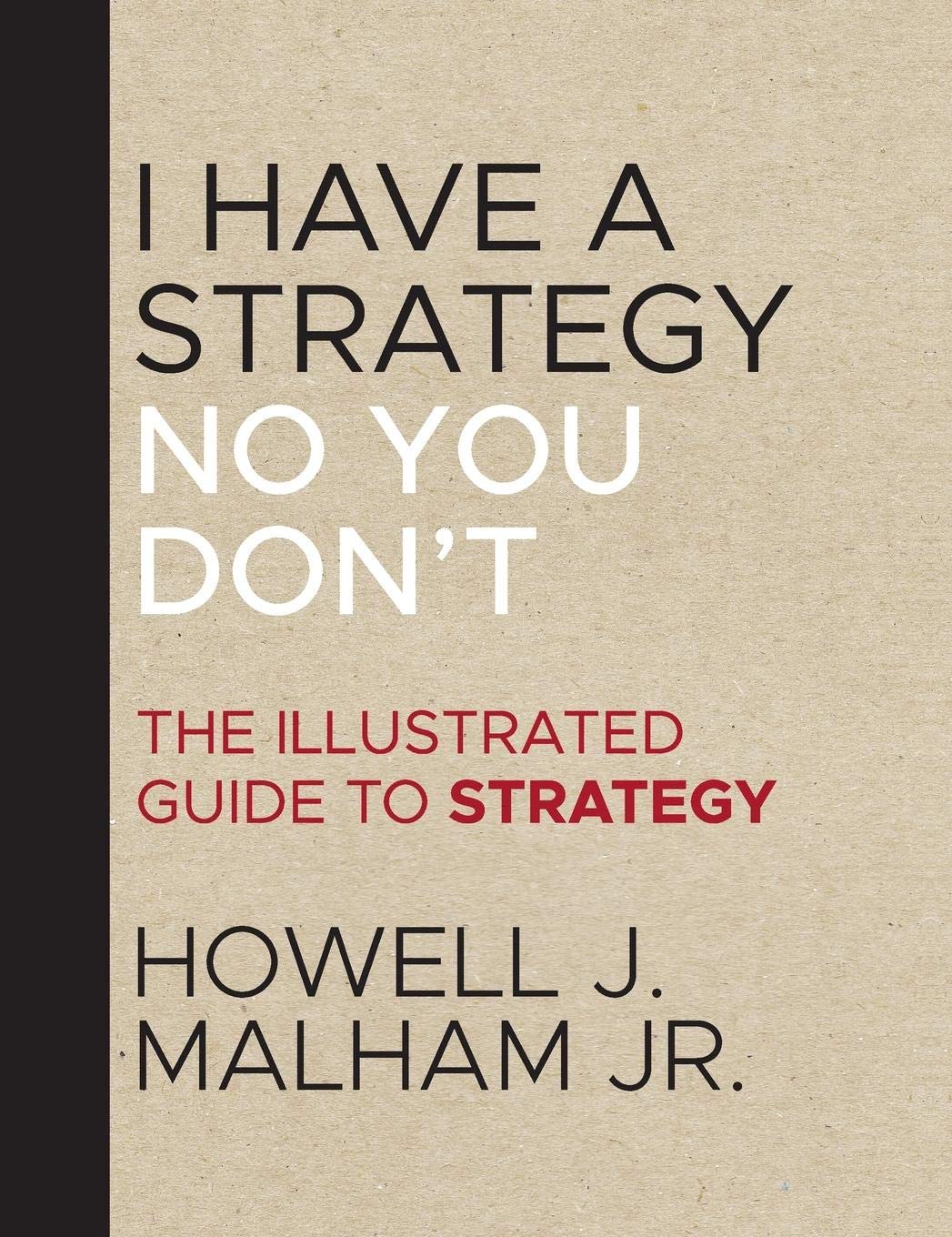
I have found Howell Malham Jr.'s 2013 book "I Have a Strategy (No You Don't); The Illustrated Guide to Strategy" to be a very useful resource.
Unlike many strategy books, the little book is simple and straightforward. Malham introduces a planning framework, which I use all the time. In fact, my team members are probably tired of me asking them to put their proposals "into the framework."
But it results in half-baked ideas getting fully baked.
Malham’s framework for articulating a strategy includes four parts:
• Purpose
• Plan
• Series of actions
• Measurable outcome(s)
There are some great examples in the book, too. This simple formula forces a discipline into strategy development that I think you may find useful.
WHAT AM I READING?
- "No Bullsh*it Strategy" by Alex M. H. Smith
- "Range" by David Epstein
- "What Makes a Strategic Plan Strategic?" by Aime J. Hosemann and Rob Zinkan
What new thoughts has this issue stirred in you, as you consider strategy and innovation for the small college?
Do you have any ideas you’d like to pursue in dialogue?
Connect with me
W. Kent Barnds
Executive Vice President for Strategy & Innovation
Vice President of Enrollment & Communication
Augustana College, Rock Island, IL 61201
wkentbarnds@augustana.edu
Connect on LinkedIn
This message is sent on behalf of Augustana College